Why Do Dogs Bring You Their Toys? What It Can Mean
Your dog walks over carrying a ball, rope or favourite plush toy and drops it at your feet — or simply stands there proudly holding it. In many cases, that little delivery is an invitation to interact.
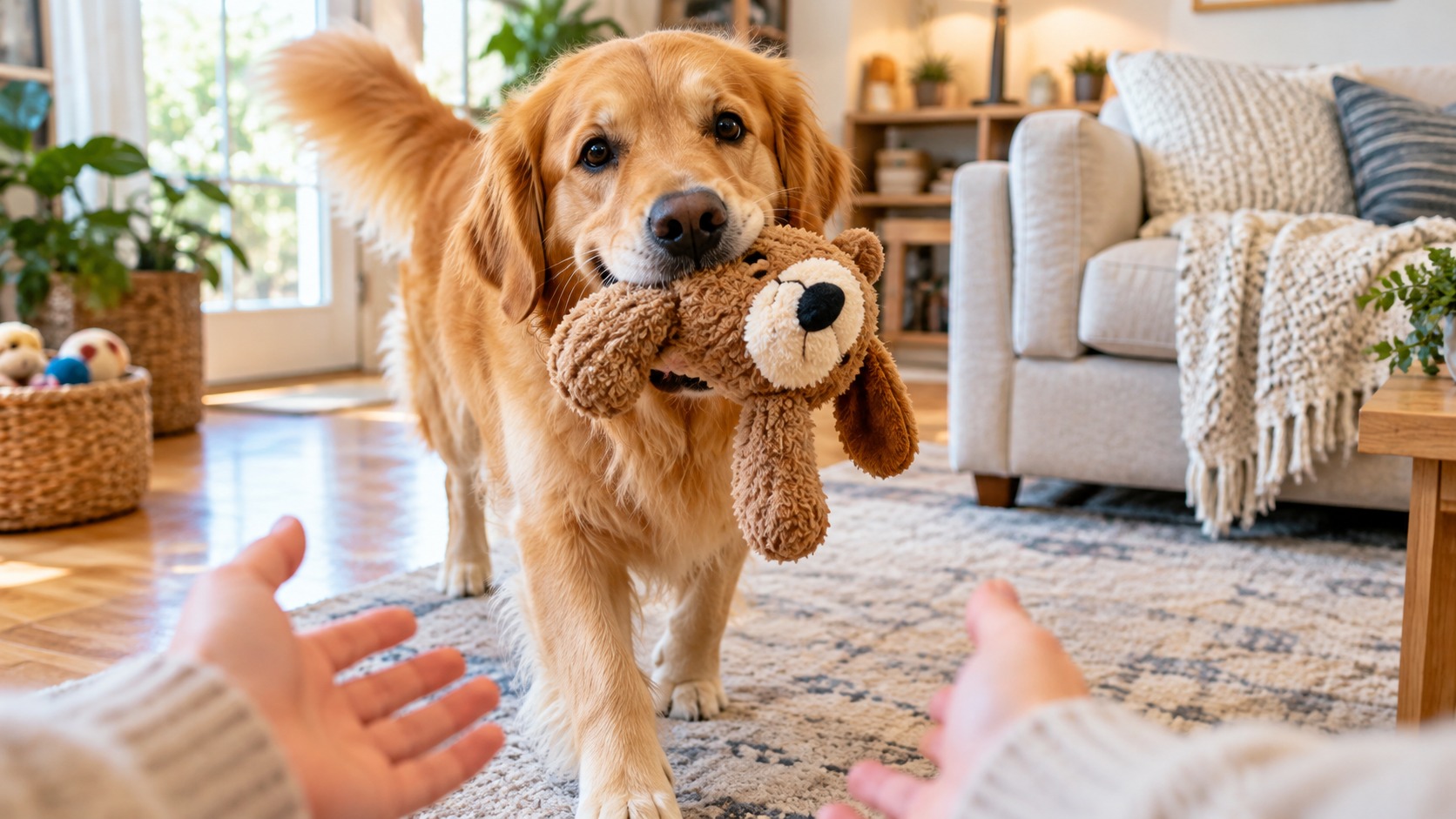
Why does my dog bring me toys?
Dogs can carry toys to people for several overlapping reasons. Some are asking for a game, some have learned that bringing an object gets attention, and others simply enjoy carrying or retrieving things. The most useful clue is what your dog does next.
1. They want you to play
If your dog approaches with a loose body, wagging tail and excited expression, then drops the toy or nudges it toward you, they may be asking for fetch, tug or another shared game. For many dogs, the person is what makes the toy especially fun.
2. Bringing the toy has earned attention before
Dogs learn quickly from consequences. If carrying a toy over usually makes you talk, laugh, pet them, throw the toy or start a game, the behaviour is likely to be repeated. Even accidental attention can reinforce the routine.
3. Retrieving can be naturally rewarding
Some dogs have a stronger tendency to pick up and carry objects than others. Retrieving breeds in particular were developed to carry items gently back to people, but individual dogs of many breeds can enjoy the same pattern.
4. They may be sharing something they value
Some dogs appear to present a favourite toy while staying close and relaxed. That does not necessarily mean they want you to take it immediately; sometimes they seem to enjoy simply involving you in the moment. Watch whether your dog invites contact with the toy or prefers to keep holding it.
5. They are excited to see you
Some dogs grab the nearest toy when a familiar person comes home. Carrying an object can become part of an excitement routine, especially if greeting with a toy has repeatedly led to calm praise or play.
6. They want a trade or another reward
Dogs can learn that handing over one object leads to a treat, another toy or a game. Teaching a calm “trade” or “drop” cue can be useful because it gives the dog a predictable, positive way to release items rather than being chased or having objects pulled from their mouth.
7. The toy itself is highly rewarding
Different dogs prefer different textures and games. Some enjoy soft toys they can carry, others prefer balls to chase, and some are most interested in toys only when a person joins the activity. Individual preference matters more than assuming every dog wants the same kind of play.
Should I always throw the toy?
No. You can choose when play starts and ends. If your dog repeatedly demands play, reward calm behaviour as well as interactive play. Short, predictable sessions can be satisfying without teaching that every toy delivery must immediately produce a game.
What if my dog will not give the toy back?
Avoid chasing your dog or prying the object from their mouth. Instead, practise a positive trade using something the dog values more, then return safe toys when appropriate. If the dog freezes, hovers over the toy, growls or snaps, treat that as possible resource guarding and get professional help rather than testing the dog.
Choose toys with safety in mind
Use toys appropriate for your dog’s size and chewing style, supervise toys that can be damaged, and remove items that are breaking apart or small enough to swallow. No toy is indestructible, and dogs vary greatly in how they play.
Frequently asked questions
Is my dog giving me a gift?
People often describe it that way, and bringing a favourite toy can certainly be a friendly social behaviour. But it is safer to interpret the action from context — your dog may be asking to play, seeking attention or simply carrying something they enjoy.
Why does my dog bring a toy when I come home?
It can become part of a greeting routine. Excitement, learned attention and an urge to carry something may all contribute.
Why does my dog bring me a toy but not let me take it?
Some dogs want interaction without surrendering the object, especially during tug-like play. If the dog remains loose and playful, this may simply be part of the game. Stiffness, freezing, growling or snapping can indicate discomfort or guarding and should be handled more cautiously.
Further reading and fact-checking sources
This PawViral article is an original editorial summary informed by the following sources. Use the linked sources for fuller context.
- American Kennel Club — Why Do Dogs Prefer Some Toys Over Others?
- American Kennel Club — How to Teach Your Dog to Trade Items With You
- American Kennel Club — How to Play Tug-of-War Safely With Your Dog
- VCA Animal Hospitals — Does My Dog Love Me?
Editorial note: AI-assisted article, reviewed against the linked sources, but not independently reviewed by a veterinarian or veterinary behaviourist.